
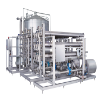

SM Series
About ReverseOsmosis
Time:2018.01.30
Reverse osmosis (RO) is very dense and has a very high removal rate for viruses, bacteriophages and bacteria, at least over 3log (>99.9%). But also must pay attention to is that in many cases, the film is produced water side still may appear microbial breeding, again depending on the assembly, the monitoring and maintenance way, that is, a system of key depends on the ability of removing microbes proper system design, operation and management rather than the nature of the membrane element itself.
1. Introduction to reverse osmosis.
ReverseOsmosis technology is the use of differential pressure gauge for membrane filtration technology, originated in the us aerospace science and technology research in the 1960 s, after gradually into civil, has been widely used in scientific research, medicine, food, beverage, water desalination, etc.
Reverse osmosis membrane pore size is small to nanoscale (1 nm = 10 to 9 meters), under certain pressure, the water molecules can pass RO membrane, and the source of the inorganic salt in the water, heavy metal ions, organic matter, colloid, bacteria, viruses and other impurities through the RO membrane, so that can pass through water and not through the enrichment of water strictly separated.
The purified water conductivity of the RO membrane was 5s/cm, which was in line with the national laboratory standard for water use. After the circulation filtration of atomic ion exchange column, the discharge resistivity can reach 18.2M.cm, exceeding the national laboratory water standard (GB682-92).
2. Basic principles of reverse osmosis.
As the pure water and salt water is separated by a semipermeable membrane, ideal ideal through a semipermeable membrane allows only water and prevent salt through, at this point the side of the membrane water water will spontaneously through a semipermeable membrane into the salt water on one side, this phenomenon is called osmosis, if put pressure on the salt water side of the membrane, then the spontaneous flow of water is restrained and slow down, when the pressure reaches a certain value, net flows of water through the membrane is equal to zero, the pressure is called osmotic pressure, when in film brine lateral pressure is greater than the osmotic pressure, the flow of water will be reversed, at this point, the water in the salt water will flow into the water, the above phenomenon is water the basic principle of reverse osmosis (RO) processing.
3. Purpose and consideration of infiltration pretreatment.
When using reverse osmosis system, pay attention to raw water pretreatment. In order to avoid blocking the reverse osmosis system, the raw water should be pretreated to eliminate the suspended matter in the water and reduce the turbidity of the water. In addition, sterilization should also be carried out to prevent microbial growth.
Because the reverse osmosis has a high requirement on the suspended matter in the original water, it is often used to test the water quality of the pollution index which is polluted by the suspended matter. In essence, this method is to measure the fouling of the anti-osmosis system under water suspension. The pollution index entering the water of reverse osmosis system is not greater than 5, and the recommended value is generally less than 3. The pH value of water should also be taken into account when preprocessing. All kinds of semi-permeable membranes have their optimum operating pH value, so they need to adjust the pH value of water according to the requirement of reverse osmosis membrane. The water inlet temperature should also be considered in the pretreatment. The water penetration of the membrane increases with the increase of water temperature, but the high temperature will accelerate the hydrolysis rate of cellulose acetate film, and make the organic film soft and easy to compaction. So, for organic membrane, usually about 20 - to control the temperature of 40 ℃ advisable, within the scope of composite membrane temperature control within about 5-45 ℃ advisable.
1. Introduction to reverse osmosis.
ReverseOsmosis technology is the use of differential pressure gauge for membrane filtration technology, originated in the us aerospace science and technology research in the 1960 s, after gradually into civil, has been widely used in scientific research, medicine, food, beverage, water desalination, etc.
Reverse osmosis membrane pore size is small to nanoscale (1 nm = 10 to 9 meters), under certain pressure, the water molecules can pass RO membrane, and the source of the inorganic salt in the water, heavy metal ions, organic matter, colloid, bacteria, viruses and other impurities through the RO membrane, so that can pass through water and not through the enrichment of water strictly separated.
The purified water conductivity of the RO membrane was 5s/cm, which was in line with the national laboratory standard for water use. After the circulation filtration of atomic ion exchange column, the discharge resistivity can reach 18.2M.cm, exceeding the national laboratory water standard (GB682-92).
2. Basic principles of reverse osmosis.
As the pure water and salt water is separated by a semipermeable membrane, ideal ideal through a semipermeable membrane allows only water and prevent salt through, at this point the side of the membrane water water will spontaneously through a semipermeable membrane into the salt water on one side, this phenomenon is called osmosis, if put pressure on the salt water side of the membrane, then the spontaneous flow of water is restrained and slow down, when the pressure reaches a certain value, net flows of water through the membrane is equal to zero, the pressure is called osmotic pressure, when in film brine lateral pressure is greater than the osmotic pressure, the flow of water will be reversed, at this point, the water in the salt water will flow into the water, the above phenomenon is water the basic principle of reverse osmosis (RO) processing.
3. Purpose and consideration of infiltration pretreatment.
When using reverse osmosis system, pay attention to raw water pretreatment. In order to avoid blocking the reverse osmosis system, the raw water should be pretreated to eliminate the suspended matter in the water and reduce the turbidity of the water. In addition, sterilization should also be carried out to prevent microbial growth.
Because the reverse osmosis has a high requirement on the suspended matter in the original water, it is often used to test the water quality of the pollution index which is polluted by the suspended matter. In essence, this method is to measure the fouling of the anti-osmosis system under water suspension. The pollution index entering the water of reverse osmosis system is not greater than 5, and the recommended value is generally less than 3. The pH value of water should also be taken into account when preprocessing. All kinds of semi-permeable membranes have their optimum operating pH value, so they need to adjust the pH value of water according to the requirement of reverse osmosis membrane. The water inlet temperature should also be considered in the pretreatment. The water penetration of the membrane increases with the increase of water temperature, but the high temperature will accelerate the hydrolysis rate of cellulose acetate film, and make the organic film soft and easy to compaction. So, for organic membrane, usually about 20 - to control the temperature of 40 ℃ advisable, within the scope of composite membrane temperature control within about 5-45 ℃ advisable.